

The End of Digital Theatre
February 2026 Newsletter*
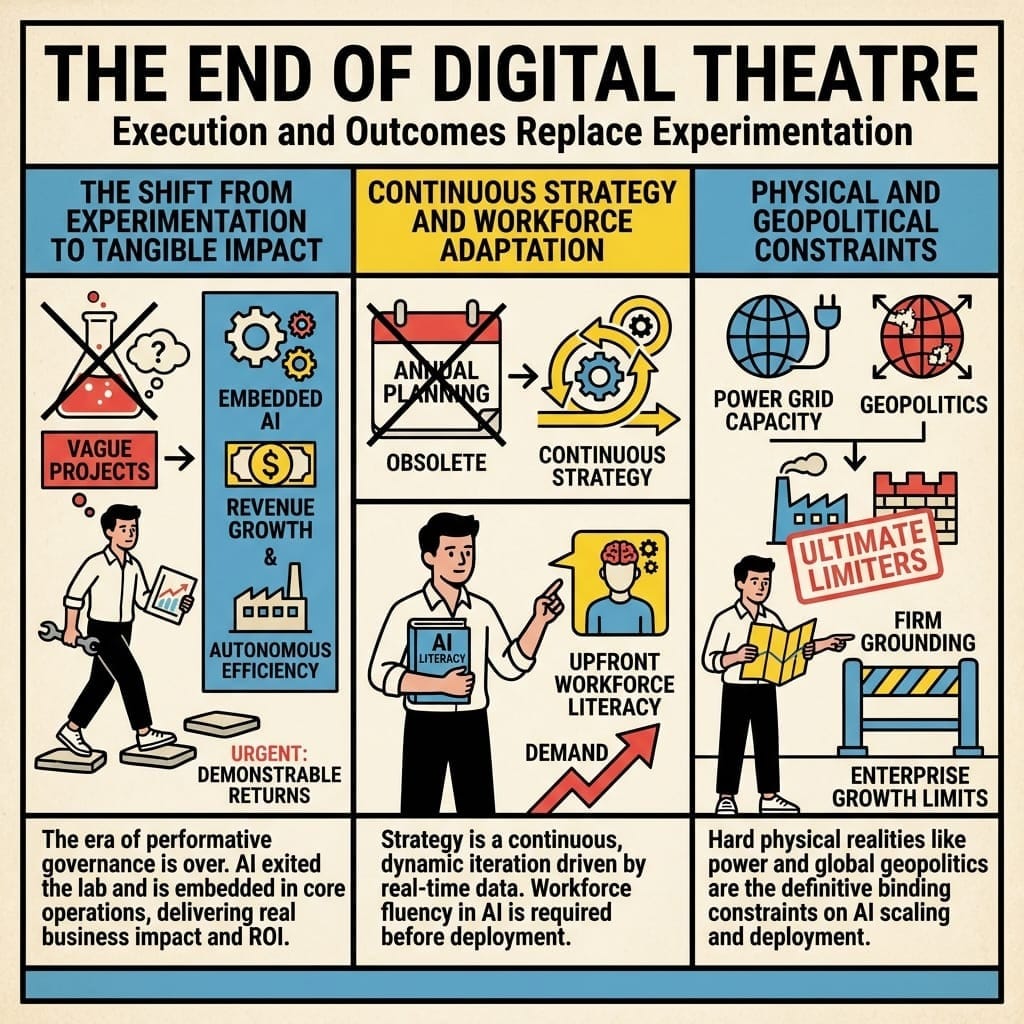
Execution and Outcomes Replace Experimentation
Organisations are abandoning bloated governance in favour of continuous strategy, embedded AI, and measurable business impact. The era of performative governance and static annual planning is over. Boards realise traditional committees are too slow, shifting power to those with true technical fluency.
Strategy is now continuous, forcing leaders to become architects of measurable impact rather than mere roadmap administrators. AI has exited the innovation lab and is now embedded directly into core operations. Driven by plummeting costs and agentic capabilities, AI now autonomously executes complex workflows. This alters enterprise economics, turning physical AI into a production-floor reality where rapid integration defines competitive advantage. Despite massive transformation budgets, technology guarantees nothing without human adoption and physical infrastructure.
Organisations are prioritising upfront workforce literacy to build sustainable habits, while hard constraints, such as power grid capacity, emerge as the ultimate limiters, grounding digital ambitions in physical reality.
What's the smallest shift that unlocks the biggest change?
*& yes, we'll get to OpenClaw & agent chains as & when the dust begins to settle
Financial boards finally get their own technology committee
Banks are spinning off dedicated technology committees from audit and risk structures, acknowledging that AI governance and digital transformation need their own forum at board level. It's a quiet admission that oversight of GenAI and agentic systems can't be squeezed into existing committee agendas alongside compliance paperwork. The real test will be whether these committees attract directors who actually understand the technology, or just become another governance theatre.
📖 2,500 words · 13 min read
Source: Bank Policy Institute
Why spending £4 trillion won't save your transformation
Global digital transformation spending approaches $4 trillion by 2027, yet the money itself guarantees nothing. Three-quarters of organisations are piling into AI, cloud, and analytics, but the sobering reality is that most will stumble not on technology choice, but on the far harder work of changing how people actually operate. The cheque is the easy part.
📖 3,200 words · 16 min read
Source: WalkMe
The Conference Circuit Reveals Where Transformation Money Is Actually Going
The 2025 conference calendar tells you more about enterprise priorities than any analyst report: AI integration, cloud migration, and automation dominate the agenda from London to Singapore. If your transformation programme doesn't overlap with at least one of these themes, you're either brilliantly contrarian or solving yesterday's problems. Worth scanning the list to see which conversations you can't afford to miss—or which bandwagons you're wisely avoiding.
📖 290 words · 1 min read
Source: Digital Adoption
When the board stops funding digital theatre and starts demanding returns
Ninety per cent of organisations are now pursuing digital transformation, but the game has changed: business leaders want demonstrable results from shorter initiatives, not multi-year commitments with vague promises. The shift from 'strategic investment' to 'show me the money' is clarifying what matters—though one suspects half these programmes will still struggle to articulate what success actually looks like.
📖 1,200 words · 6 min read
Source: Digital CxO
Financial services stop experimenting with AI and start embedding it
Banks and insurers are shifting AI from the innovation lab to core operations—credit decisions, fraud detection, customer service—where it actually matters. Embedded finance is maturing in parallel, turning every digital interaction into a potential payment rail. The experimental phase is over; the question now is execution, not feasibility.
📖 850 words · 4 min read
Source: Barchart/ABNewswire
When the mid-tier model outperforms the flagship
Anthropic's Sonnet 4.6 delivers Opus-class performance at mid-range pricing—a fivefold improvement in computer use capability that eliminates the intelligence-versus-cost trade-off. The real shift isn't the benchmarks; it's that autonomous workflows previously requiring premium models now run at $3 per million tokens, fundamentally changing the economics of AI deployment. Suddenly, every legacy system without an API becomes automatable at scale.
📖 950 words · 5 min read
Source: MarketingProfs
When Prior Auth Takes Six Minutes Instead of Seventy
UiPath's agentic AI just cut medical record review time by 90% — from over an hour to six minutes. That's the sort of operational shift that doesn't just save time; it fundamentally changes what's possible when clinicians aren't drowning in administrative theatre. Worth watching whether this scales beyond the demo.
📖 650 words · 3 min read
Source: UiPath
Fujitsu bets the development team becomes optional
Fujitsu's new platform deploys multiple AI agents to handle the entire software development lifecycle—requirements through to testing—without human developers touching the code. It's the logical endpoint of automation: not augmenting the team, but replacing it entirely. Whether that's visionary or reckless depends rather heavily on what happens when the requirements turn out to be wrong.
📖 650 words · 3 min read
Source: Fujitsu
America's oldest bank trains every employee on AI before deploying it
BNY Mellon put its entire workforce through AI training on its Eliza platform before rolling out productivity tools—a rare inversion of the usual 'deploy first, train later' approach. Goldman Sachs reckons this could lift earnings per share by 19%, though one suspects the real dividend is avoiding the chaos of untrained staff wrestling with AI they don't understand. Getting everyone literate before switching on the machine turns out to be rather sensible.
📖 1,100 words · 6 min read
Source: CNBC
Physical AI crosses the deployment threshold
When 58% of business leaders are already using physical AI in operations—and that's set to hit 80% within two years—we've moved past the 'should we?' phase into 'how fast can we scale?' Humanoid robots are shifting from experimental outliers to production floor reality, which means the competitive advantage now goes to those who can deploy quickly and integrate well, not to those still forming committees to explore the potential.
📖 750 words · 4 min read
Source: Manufacturing Dive
When product managers stop waiting for perfect clarity
Business outcomes are no longer downstream concerns—product managers must now frame strategy in business terms as organisations flatten, AI accelerates execution, and expectations rise for delivering faster with less structure. The shift isn't about seniority or scope—it's about anchoring influence in judgment rather than process, moving forward despite incomplete information rather than waiting for alignment that never arrives.
📖 1,800 words · 9 min read
Source: Amy Mitchell (Substack)
When revenue becomes the scorecard, strategy moves upstairs
Revenue growth is now the number one success metric for product teams, with profitability joining it at the top of the board report. The consequence: a 5% rise in senior leadership deciding product strategy and a shift towards output measures like roadmap completion tracking. If you're a product manager wondering why your influence feels lighter, you're not imagining it—the macroeconomic squeeze has centralised decision-making, and the essential skill now is translating high-level business goals into specific product outcomes, evolving from 'owner of the roadmap' to 'architect of impact'.
📖 2,200 words · 11 min read
Source: Ant Murphy (Medium)
When asking 'why' becomes more valuable than knowing 'how'
Product managers are finally cottoning on to what tight budgets have been screaming at them: outcomes matter, outputs don't. The shift means challenging every initiative before it hits the roadmap—does it solve a real customer problem or is it just there because it's always been there? AI can crunch the data, but only critical thinking separates features that deliver value from features that simply ship.
📖 1,500 words · 8 min read
Source: Productside
Change management's fatal flaw: it assumes stability exists
Traditional change models—with their neat phases and tidy frameworks—presume you're moving from one stable state to another. In a polycrisis world where disruption is continuous, that premise is dead. The catalysing insight isn't a new methodology; it's accepting that permanence is the illusion and building leadership capability that can hold contradictions: grounded yet unleashed, structured yet adaptive.
📖 1,200 words · 6 min read
Source: Results Map
Uncertainty breeds resistance faster than any restructure
The article argues that transparency isn't corporate virtue-signalling—it's tactical. When leaders involve employees before decisions are made rather than announcing them afterwards, resistance drops and useful intelligence surfaces. The advice to roll out change in phases is hardly revolutionary, but the underlying insight holds: people resist what's done to them, not what they help shape.
📖 900 words · 5 min read
Source: Ivy Exec
Stop Planning Change. Start Building the Habits That Make It Stick.
Most change programmes collapse under their own ambition—too much strategy, too little follow-through. The discipline lies in reflection cadences that catch fatigue early, empowering champions who aren't just cheerleaders, and stakeholder check-ins that actually surface what's breaking. It's unglamorous work, but it's the only kind that lasts.
📖 1,200 words · 6 min read
Source: Strategico Consultants
When the lights go out, AI ambitions follow
NVIDIA's $68 billion quarterly revenue confirms AI demand is real, but power grid capacity is now the binding constraint on deployment. The White House summoning tech firms to formalise energy cost pledges signals that infrastructure physics—not algorithms or capital—will determine who scales and who stalls. Worth noting: this is the first technology wave in decades where the grid matters more than the code.
📖 243 words · 1 min read
Source: Tech Startups
Context beats data: the shift that rewrites competitive advantage
London Business School faculty argue that AI's real value lies not in processing power but in delivering context—turning raw capability into strategic insight. The shift from outsourcing processes to buying context-as-a-service fundamentally changes what organisations need to own versus rent. It's the difference between having all the facts and knowing which ones actually matter.
📖 2,200 words · 11 min read
Source: London Business School
When the boardroom became a war room
Multinationals are elevating geopolitics from peripheral risk to core governance. Boards now drive decisions on capital allocation and supply chain design—not just rubber-stamp them. The shift requires directors with expertise in trade policy and crisis management, and a culture willing to argue without consensus. Call it the rise of 'geobusiness', if you must.
📖 1,000 words · 5 min read
Source: World Economic Forum
Strategy is no longer annual—it's continuous
Organisations have shifted from yearly planning cycles to continuous iteration based on real-time data. The challenge isn't just balancing short-term profitability with long-term innovation—it's accepting that strategy must now be dynamic, not static. Those still running annual planning cycles are already behind.
📖 2,500 words · 13 min read
Source: Six Paths Consulting
Less change. More impact.
Will
Spot a catalyst in your organisation?
Let's talk →