I'm a Change Catalyst
Find the one thing that changes everything.
You don't need a transformation programme.
You need to find the one thing that's actually in the way—and someone to move it.
The problem with big change
Transformation loves big plans. Eighteen-month roadmaps. Steering committees. Workstreams with names like "Future State Operating Model."
But here's what I've noticed after years of working inside organisations that are trying to change: real momentum usually comes from something smaller.
A governance tweak that unblocks a stuck team. A reframe that shifts how the Board sees risk. A planning fix that makes delivery predictable. One small shift. Disproportionate results.
Most organisations aren't stuck because they lack ambition or capability. They're stuck because they can't see the one thing that would unlock everything else.
That's what I find.
What I actually do
I call it being a Change Catalyst. Not a consultant who embeds for eighteen months. Not a coach who asks how you feel about the roadmap. Not a contractor who builds what you've already designed.
A catalyst finds the thing. Then moves it. Then leaves.
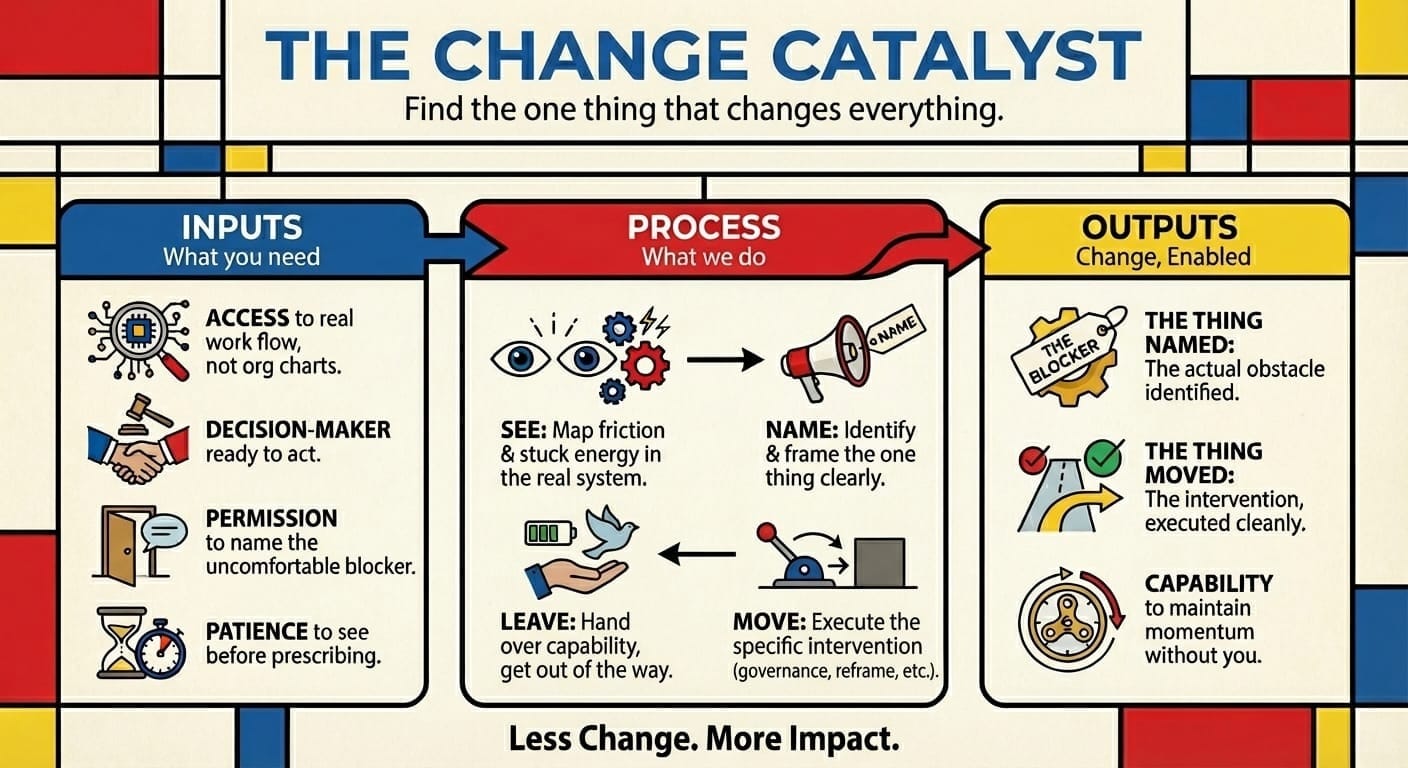
The process is simple:
See — I watch the real system, not the org chart. Map the friction. Notice where energy gets stuck.
Name — Identify the one thing. Frame it so people can hear it. Often the blocker is uncomfortable to say out loud—which is exactly why it hasn't been said.
Move — The intervention itself. Sometimes it's governance. Sometimes it's planning. Sometimes it's a conversation that should have happened months ago.
Leave — Hand over capability. Get out of the way. You don't need me to maintain momentum—you need to know how to keep going without me.
What I need from you
This only works if a few things are true:
Access to how work really happens. Not the process diagram. The actual flow. Who talks to whom. Where decisions stall. What never gets escalated.
A decision-maker who'll act. Diagnosis without action is just expensive observation. If you're not ready to move on what we find, we're both wasting time.
Permission to name it. The blocker is often something people have been avoiding. A relationship that isn't working. A governance structure that protects the wrong things. A priority that everyone knows is wrong but nobody will say.
Patience before prescription. I need time to see before I tell you what I see. The first hypothesis is rarely the right one.
What you get
The thing named. The one decision, conversation, or process fix that's actually in the way. Not a list of seventeen recommendations. Not a backlog. The thing.
The thing moved. The intervention, executed cleanly. Not a plan for change—actual change.
The capability to keep going. You won't need me to maintain this. That's the point.
Less change. More impact.
I work fractionally because I'm not here to run your programme. I'm here to find the intervention that moves things.
That might look like strategic counsel at Board level. Or hands-on product delivery support. Or mentoring your people to see what's really in the way. Different entry points. Same principle.
Find the one thing. Move it. Leave you better equipped than I found you.
What's the one thing that's blocking everything else in your organisation? Let's find it together.
