The Score: How to Stop Playing Someone Else's Game
Rory Sutherland twice (!) recommended The Score in a recent monthly MAD//Masters Live Q&A, and I'd agree. It's likely one of the most interesting books that will be published this year.
C. Thi Nguyen's The Score is a philosopher's dissection of something most of us sense but struggle to articulate: the quiet way metrics hijack our judgment.
The central thesis is deceptively simple. When we measure something, we change our relationship with it. Not occasionally. Inevitably. The fitness tracker doesn't just record your steps; it redefines what a "good day" looks like. The KPI doesn't just measure performance; it becomes the performance. Nguyen calls this value capture, and once you see the mechanism, you cannot unsee it.
What makes this more than a standard critique of quantification is Nguyen's concept of objectivity laundering. Every metric begins as a subjective human choice — someone decided that this number matters more than that one. But by the time those choices have been processed through an algorithm or ranking system, they emerge wearing the disguise of objective truth. University rankings are perhaps the most familiar example. The formula is arbitrary. The output feels indisputable. The "laundry" works by transferring value-laden decisions into what appear to be hard facts.
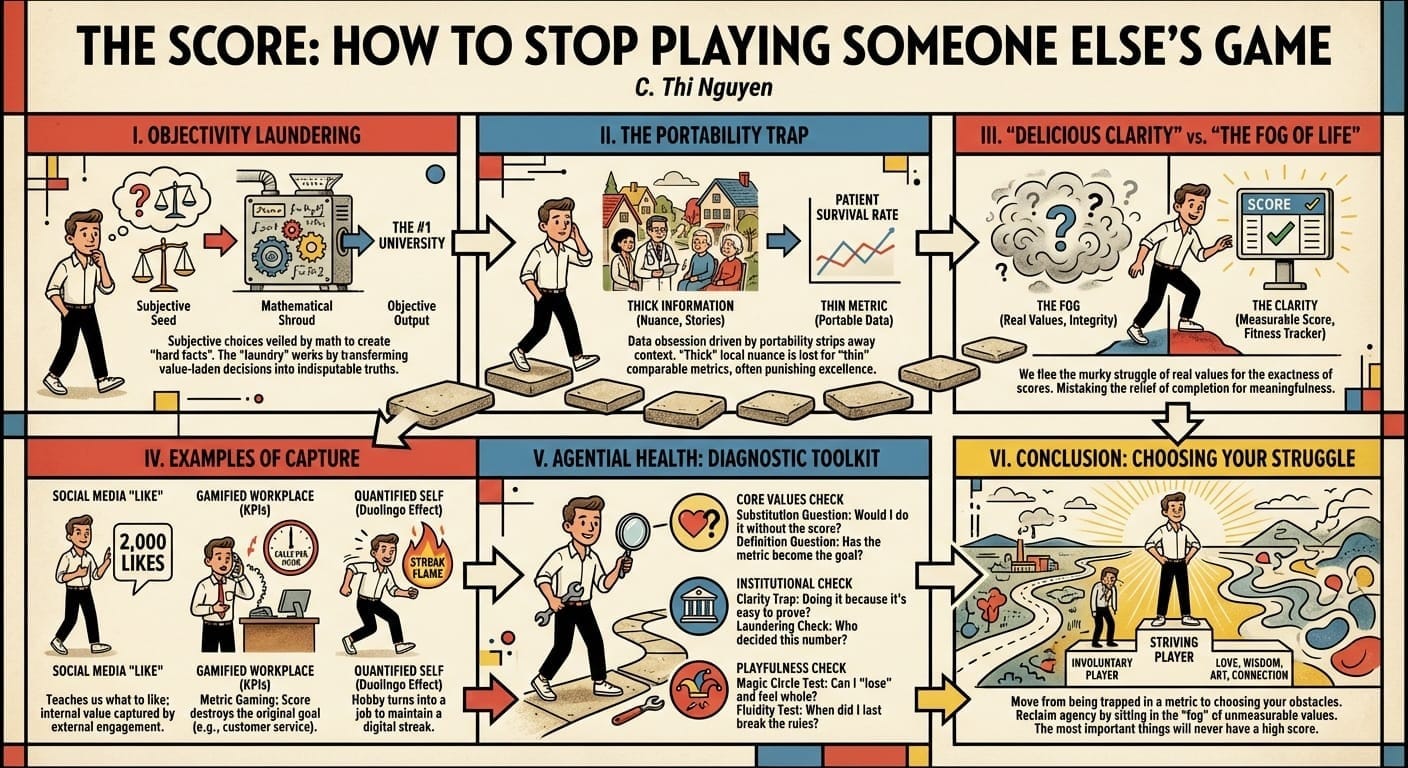
There's a wonderfully useful distinction Nguyen draws between what he calls the "fog of life" and "delicious clarity." Knowing whether you're a good parent, a good leader, or living a meaningful life is genuinely murky work. There is no scoreboard for integrity. A fitness tracker, by contrast, tells you precisely when you've "won" the day. The trap, Nguyen argues, is that we flee the fog for the clarity — not because the score matters more, but because the ambiguity is exhausting. We mistake the relief of completion for the satisfaction of meaning.
The practical applications are immediate. Nguyen offers a diagnostic toolkit that's worth the price of the book alone. One question in particular has stayed with me: "If the app stopped recording this tomorrow, would I still do it?" It's a disarmingly simple test, and the honest answer is frequently uncomfortable.
This isn't an anti-data polemic. Nguyen acknowledges that metrics serve genuine purposes. His argument is subtler and more important: that we should be striving players who choose their obstacles consciously, rather than involuntary players trapped inside someone else's scoring system.
In an era where AI is about to generate metrics at unprecedented scale and speed, understanding the mechanics of how scores shape behaviour feels less like philosophy and more like essential literacy. The most important things in life — love, wisdom, art, connection — will never have a high score. And that, Nguyen would suggest, is precisely the point.